Showing posts with label Second Life Treasures. Show all posts

Sunday, February 19, 2012

Venexia - Realm of the Vampire


In medieval time, a great plague, pustulous and deadly, descended on the western world and decimated its human populations to the point of near extinction. Long hidden from the formerly greater society of humans, a society of Vampires emerged from the shadows to fill the void left by a weakened humanity, imposing a new social order, a dark realm  in which they are dominant. The court of this new vampiric social order is seated in the great maritime city of Venexia. Outside the city, a blood thirst reign of terror threatens those remnants of humanity. But, within Venexia, the vampires of the city abide by laws they promulgated to protect and preserve a stock of humans from predatory excess as the extinction of humanity would mean the extinction of their own kind as well. For their part, the human residents of the city are permitted to live a near normal life as long as they accept the rule of their vampire overlords and provide what is expected of them.  The city has developed its own style, culture, and social hierarchy in which vampires and humans coexist, uneasily, in this realm of the Venexian Vampires. So goes the story behind this fascinating role play. 

Click on the pictures to enlarge them for better viewing. 


Venexia is a gothic vision of Venezia, the city of Venice. It is densely constructed as one would expect of a city with ancient medieval origins. This is not a faithful replication of Venice. One will not find a Rialto Bridge or Grand Canal in this city. Rather, it is an interpretation that evokes an atmosphere of fading opulence and demonic domination. The details one sees around you as you walk the city are incredible and must be experienced. Above all, Venexia is designed to be a thriving virtual community with public and private spaces including private residences. It provides a wonderful stage for its role play. And, even more than that, Venexia is a Second Life treasure. Kudos to Baal Zobel and Kora Zenovka, the builders and game masters of this treasure.     


Piazza Grande
Visitors to Venexia need to obtain a visitor's tag before teleporting down to the city.  Once reaching the city, it is best to try to find your way to the Piazza Grande, a large public square that is a central meeting place for residents and visitors. Piazza Grande is recognizably inspired by the Piazza San Marco in Venice. Naturally, visitors should strive to be unobtrusive so as not to interfere with the role play.  But, I've met some very sociable role players who were more than willing to answer questions. Just use good judgement and courtesty when interacting with the role players. 


Venexia role players at the Piazza Grande.


Venexia is a medieval city of canals and bridges. It's a walking city and a maze of walkways and alleys. Be prepared to be perpetually lost. But, you'll discover some charming open squares, grand buildings, and a marvelous shipyard. Venexia is a SL photographer's delight. I might even say that it can be charmingly romantic. However, there is a tension here from the underlying horror that permeates this city.    

Blood Offering
Entering Venexia, I went into the nearby tavern called The Green Dragon. On the menu, I had a choice of soup, stew, or blood. One can find offerings of bloody refreshments throughout the city. It must require an endlessly flowing river of blood to satiate an entire city of vampires every day, every week, every year.


The portrait of the Doge of Venexia leaves no doubt as to the nature of the rulers of Venexia


Vampires are powerful and arrogant. In Venexia, they will affect aristocratic tastes and assume aristocratic hauteur to those of lower social rank, human and vampire. They are reserved; but can be agreeably friendly. However, beneath that reserve and that smile lurks a suppressed bloodlust that can suddenly erupt in a demonic fury. Keep in mind the true nature of the vampire. They are undead corpses animated by the power on earth of them that fell from heaven. That nature was made evident to me when I wandered into the common lair of the Venexian vampires. The cold chill of terror descended on me.


So, I called on Jaysun to accompany me. He arrived dressed in the fashion of 1830 Paris. Very handsome, I might add. It was very reassuring to have him here. The chill departed from me. And Jaysun was very impressed with this city. Our first stop was at Venexia's theater, The Teatro.

  
Teatro, Venexia

Vampires and Venexians appreciate and cultivate the arts. There is an active theater company that produces plays in this theater. A poster outside the Teatro announces the plays. The theater's interior is a delight. Jay and I walked onto the stage, imagined the applause and took our bows. The next attraction on our tour agenda is the basilica, Venexia's version of the Basilica di San Marco.

The Gilded Mosaic Nave of the Basilica in Venexia

The Basilica is truly magnificent. But it is not a house of holy worship.
This is Venexia, the realm of vampires. This is unholy ground.


A touch and suddenly I found myself on the sacrificial alter of a Black Mass.
Jaysun gave out a warning. There is danger in this.


Jay was right. One should never dabble in such things. There are consequences.
I'm finding Jaysun's neck very tempting.


Venexia

Venexia is part of the SGS game system. Information about Venexia and its role play can be found on the SGS website:


and also on the blog, Venexian Vampires: The Chronicles of Venexia


This post was recently featured in New World Notes


and in Eddi Haskell's Second Life (a really great blog)


The official website of the City of Venice. Take the virtual tour and virtually walk the streets of the city:


Another wonderful virtual tour of Venice is found on the Italy Guides website:


The dress that I am wearing is from MEB Fashion and is called Revello. Revello and other selections from the MEB collection are available at Mariko, my fashion boutique on the Grande Rue in Mont Saint Michel.

Mariko


Tuesday, February 15, 2011

Mariko Magic: City of Darkness


Loshi by GothiCatz

There's something about the look and feel of leather that is so irresistible. Maybe because it's so evocative.  Leather is attitude, confidence, individualism, and rebellion. And maybe because I look so darn hot and sexy in leather. Well, I always have my eye out for that magical leather outfit. So look at what I found at GothiCatz. It's called Loshi.

Click on the pictures to enlarge them for better viewing.


Created by Looloo Beck, designer and owner of GothiCatz, Loshi has a powerful look that is dark and post apocalyptic. Loshi comes with a highly detailed, tight leather jacket with sculpted folded up sleeves, a black feather collar, and matching pants with sculpted cuffs and belt. It has deletable menu driven resizers and sells for L$520. Loshi shouts High Adventure! Well, I was up for it. So donning the outfit, I set out looking for danger and intrigue in the Walled City of Kowloon.


Nightfire in the Walled City


Kowloon, the Walled City, in Second Life
Infamous and shadowy, the Walled City of Kowloon was an accident of history, a no-man’s land situated between China and the New Territories of British Hong Kong. Originally, a Chinese outpost with formidable defensive walls, the fort was attacked and briefly occupied by the British in 1899 which established a tenuous British claim on the city. During WWII, the Japanese tore down the walls and used the material to build nearby Kai Tak Airport. After the Japanese surrender, the city was left totally ungoverned as neither the Chinese nor the British exercised control. The Walled City became a haven for criminals and fell under the control of organized crime syndicates known as Triads. The city was infamous for its many brothels, gambling parlors, opium dens, and unlicensed doctors and dentists. Yet, it offered a unique freedom that attracted 33,000 residents to its 6.5 acres. The Walled City grew rapidly into a dystopian megacity. Buildings were constructed on top of each other, and they merged to form a single solid block of construction that reached a uniform height of about 10 stories. The construction was so dense that the city’s lower levels never saw sunlight and had to be illuminated by fluorescent lights. It was a City of Darkness. In the 1970’s, a series of massive police raids broke the control of the Triads. In 1987, the Chinese and British jointly agreed that the decaying city should be torn down. In 1994, the Walled City was demolished and replaced with a public park.


I hope you enjoyed this look at Loshi by GothiCatz. If you have a taste for high adventure, head out to GothiCatz and get acquainted with Loshi. And then set sail for Kowloon, a Second Life treasure, and explore the alleys of that City of Darkness.


GothiCatz
http://slurl.com/secondlife/GothiCatz/121/82/23

Kowloon in Second Life
http://slurl.com/secondlife//144/10/24


Video: City of Darkness - Life in Kowloon, The Walled City


.

Sunday, August 22, 2010

Second Life Treasures: Sistine Chapel

Sistine Chapel in Second Life
The room is just a simple rectangle roofed by a flattened barrel vault, and yet it is one of Western Civilization’s greatest treasures. This is the Sistine Chapel, and on its walls and ceiling are magnificent frescoes by Italian Renaissance painters Dominico Ghirlandio, Sandro Botticelli, Pietro Peruguni, Cosimo Roselli, and the indomitable Michelangelo Buonarroti  The Sistine Chapel was built between 1475 and 1483 on the grounds of the Vatican. It’s the Pope's chapel, and, as the site of the conclave of the College of Cardinals in the election of new popes, it is a profoundly important space. Incredibly, the Sistine Chapel has been faithfully reproduced in Second Life. Now, the Sistine Chapel is one the greatest treasures of this virtual world.

Click on the pictures to enlarge them for better viewing.

The South Wall (Left), the North Wall (Right), and the Entrance Wall


Sistine Chapel in Vatican City
The Sistine Chapel in Second life is located on Vassar Island, the virtual campus of Vassar College. This accurate-to-scale recreation was built by Stan Frangible, who in real life is Steve Taylor, director of academic computing services at Vassar College.  The build was opened to the pubic in 2007. Its purpose is to explore how virtual reality can be used to help students learn about art and architecture.


The walls of the Sistine Chapel are divided into three tiers, the lowest tier is frescoed with faux tapestries of gold and  silver, the middle tier has two facing cycles - on the south and entrance walls are paintings portraying the story of Moses and on the north and entrance walls, the Life of Christ. On the upper tier, set between the windows, are images of the first popes, all martyred in times of great persecution.  But our eyes are inevitably drawn upwards to the ceiling. To the glorious frescoes of Michelangelo.


Ceiling of the Sistine Chapel in Second Life

In 1508, Michelangelo was commissioned by Pope Julius II to repaint the ceiling of the Sistine Chapel which had been frescoed with an uninspired blue star-spangled sky. Decorating the ceiling was assumed to be a lesser commission compared to the paintings on the walls. Michelangelo was to paint the Twelve Apostles and a few ornaments on the ceiling. However, he conceived a far grander design. At its heart are nine central panels showing stories from Genesis, from the Creation to the Fall of Man, to the Flood and the rebirth of mankind with the family of Noah. Completed in 1511,  Michelangelo's revolutionary depictions of the human body and his creative use of light, form, and color were controversial at the time; but, they would have a profound influence on subsequent Renaissance art and would be embraced by generations of artists.


Creation of Adam

The most famous panel is Michelangelo's iconic depiction of the creation of Adam. Michelangelo's Adam is beautiful. He is the perfect man created in the image of God. Of the entourage of angels surrounding God, two are given special favor. Under the arm of God is a feminine angel. And the thumb and forefinger of God touch an angel that is a child. Many art historians contend that the woman is the uncreated Eve and the child is the human race that is to follow. Others believe that the woman is Sophia, devine wisdom. But, consider the child. In the Eucharist of the Catholic Church, only the thumb and forefinger of the priest touch the Host - the Body of Christ. Is Michelangelo foretelling of Mary and the Coming of the Savior? But, that interpretation raises a serious theological dilemma concerning free will and predestination. Isn't art marvelous and fun?


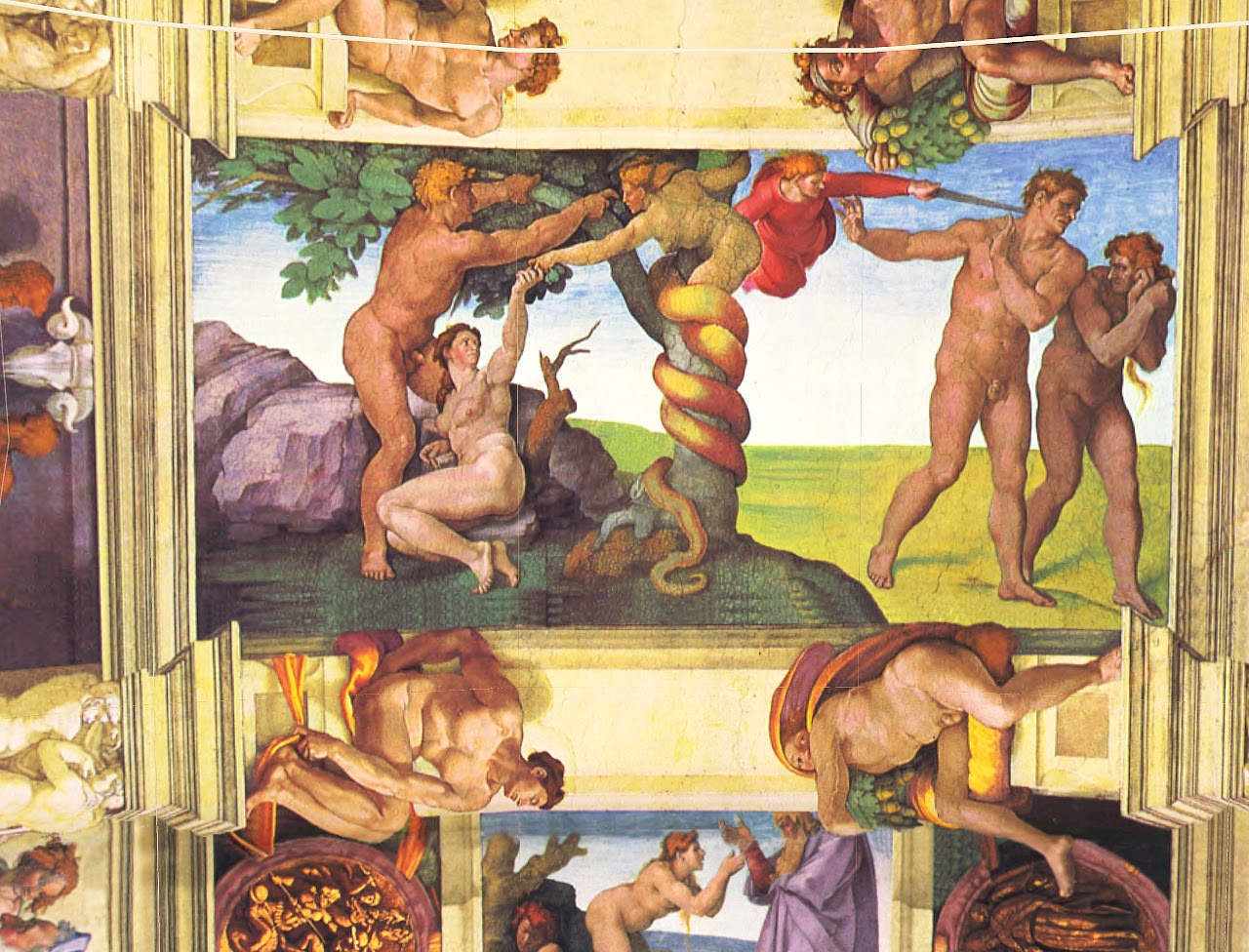
The Temptation and Expulsion from the Garden of Eden

One favorite of mine is the Temptation and Expulsion from the Garden of Eden. The flow of this composition is so dramatic. In the Temptation, Eve is turning towards the Serpent and reaches out to  accept the offered fruit from the hands of the Temptress. An act of will because the Temptress can persude but cannot coerce. Adam seizes a branch of the tree to aggressively reach forward. 'For God doth know that in the day ye eat thereof, then your eyes shall be opened, and ye shall be as gods, knowing good and evil,' tempted the Serpent. The center of focus of the Temptation is naturally Eve. Her skin is smooth; her body, voluptuous. Eve is idealized feminine beauty. In the Expulsion, she becomes hideous and haggard, hunched over, clutching her hair in shame. But, the focus of the Expulsion is Adam. There is dismay and pain in his face Art historians say that Adam's arms and hands are raised to ward off blows from the pointed sword welded by the cherubim in red (joined to the Serpent to symbolize the duel nature of good and evil) that is driving the pair from Eden. If so, shouldn't his arms be raised higher? I think Adam is refraining from looking back at paradise, painfully knowing what he has lost - his closeness to God. It is Eve who looks back, from the barren land of the Expulsion, to the verdant lushness of the paradise lost. What is it that is reflected in her face?


The alter of the Sistine Chapel in Second Life

At the end of the chapel is the alter of the Sistine Chapel and, above the alter, spanning the entire wall, is Michelangelo's tour de force, The Last Judgement.  A quarter century after finishing the Sistine Ceiling, Michelangelo, at age 60 and comtemplating his own mortality, was at work painting The Last Judgement, completing the fresco in 1541.  The Last Judgment is a depiction of the resurrection of the dead and Second Coming of Christ as foretold in Mathew 25: 31-46.


Michelangelo's Last Judgement

Christ has come in his glory, and all the saints and angels with him, and each person who has ever lived will be judged with perfect justice. Christ raises His right hand. To those at His right hand, He says, “Come, you that are blessed by my Father, inherit the kingdom prepared for you from the foundation of the world." He lowers His left hand. To those at His left hand, Christ says, “You that are accursed, depart from me into the eternal fire prepared for the devil and his angels."

The scene is tumultuous and frightening. The blessed are hoisted upward by straining angels. The doomed are pummeled by angels as demons drag them down. The bodies in this fresco are not the beautiful and perfect bodies painted on the Sistine Ceiling. They are grotesquely distorted. And all that nakedness above the alter was decried as immoral at the time. Indeed, after Michelangelo's death, there were calls for the destruction of the fresco. However, as a concession to modesty, Church authorities had draperies painted over the most offensive nudity. So notice, on many of the figures, the wisps of strategically placed cloth.

Many of the figures are fascinating studies with interesting stories.  One that must be pointed out is Saint Bartholomew who is holding his own skin. At his martyrdom, the saint was skinned alive. It is said that the face on the skin is a self portrait of Michelangleo.


With Jaysun viewing the Raphael Tapistries.

On special occasions, the faux tapestries of the lower side walls of the chapel are covered with real tapestries designed by Raphael and woven in Brussels from 1515 to 1519. The Raphael Tapistries depict events from the Life of Saint Peter, the Life of Saint Paul and the Acts of the Apostles. They are rarely seen in public; but can be viewed in Second Life's virtual Sistine Chapel with the mere click of a mouse.

The Raphael Tapestries in Second Life


During a trip to Rome, my sister and I had a memorable private after-hours tour of the Sistine Chapel with an art historian (the tour was arranged by my parents as a gift to us). It was a thrill to be able to spend considerable time in the chapel without a crowd. That experience is recreated virtually on Vassar Island for all to experience. And in Second Life, we can fly around the chapel and up close to the ceiling where we can get a unique prospective on the size of the paintings that could only be had in this virual world. Steve Taylor and Vassar College should be commended and thanked by all in Second Life (and by Linden Labs) for making this wonderful treasure available to all of us.


Sistine Chapel at Vassar Island:
http://slurl.com/secondlife/vassar/165/91/24

Many of the pictures of the artwork used in this reproduction were obtained from the Web Gallery of Art which has an virtual tour of the Sistine Chapel:

http://www.wga.hu/tours/sistina/index.html

The Vatican also has an extraordinary virtual reproduction of the Sistine Chapel:

http://www.vatican.va/various/cappelle/sistina_vr/index.html


Videos:

Flying Visit to the Sistine Chapel Vassar College Second Life


Scene from the Michelangelo Code


Max Newbold and Sez Zabelin (Dr. Beth Harris and Dr. Steven Zucker in real life) provide an incredible video tour of the Sestine Chapel in Second Life. This is one of the best videos on the art in the Sistine Chapel, real life or Second Life, period.  It is an outstanding example of the potential of virtual worlds to educate and enlighten.  Use the links below to take the video tour.


Other Second Life Treasures:

Mont Saint Michel


Saturday, November 28, 2009

Le Mont Saint Michel in Second Life


Le Mont Saint Michel, A Second Life Treasure

The Great Age of Exploration began in the 15th century when intrepid Portuguese ship captains and crews set out in their caravels from the port of Lisbon in search of new maritime trade routes to the East Indies and Cathay. Over the next 400 years, previously unknown continents, islands, peoples, cultures, and natural wonders were discovered by Western explorers as they pushed to the ends of earth. Today, there is no place too remote not to have been beheld by the eyes of humanity. Yet, we still have the urge to discover and explore distant lands, and now there are virtual worlds to explore.


Moeka Kohime, Creator of Mont St. Michel

Go to the map of Second Life, zoom out, and watch the islands and sims become as stars in a galaxy of multitudious stars. And know that each star in this galaxy is the creative work of some person or group of persons. The thrill is discovering one that shines bright in the firmament.  I have recently been exploring a super nova named Le Mont Saint Michel.


Le Mont Saint Michel in Second Life is an incredible achievement. It is a one-to-one recreation of the world famous tidal island of Le Mont Saint Michel in northern France. The creator of this sim is Moeka Kohime, a graphic designer from Japan. She fell in love with the island during a visit to France and took that love to Second Life. I can't even begin to imagine the amount of research, graphical expertise, and artistic talent that went into this re-creation. The detail here is astounding. Click on the pictures to enlarge them for better viewing. And to gain some perspective for what Moeka has created, compare the picture below of the real Mont Saint Michel with the picture of its Second Life counterpart. Moeka Kohime has created a Second Life treasure.

Mont St. Michel in Real Life

Mont St. Michel in Second Life


Mont Saint Michel is a small rocky islet located 1 mile off the coast of Normandy in northwest France in the Bay of Mont Saint Michel in the English Channel. The island was consecrated to the Archangel Saint Michel in 708 AD and is famous for its Benedictine abby, a 13th century Gothic masterpiece, towering over 500 feet above the sea. Mont Saint Michel is actually an outcropping of granite conspicuously jutting out of a vast sandbank and exposed to powerful tides that can rush in over the tidal flats at speeds, famously described by Victor Hugo, ‘as swift as a galloping horse.’ In medieval times, Mont Saint Michel was connected to the mainland by a natural land bridge which was submerged at high tide and exposed at low tide. In present times, the rocky islet is entirely surrounded by water twice a month, becoming a tidal island. The actions of the tides give Mont Saint Michel a wonderful mystical quality. In 1979, UNESCO named Mont Saint Michel a world heritage site.


The Steepled Church Crowning the Abby


The Magnificent Interior of the Church

Benedictine Cloister Opening to the Bay

It’s a long walk up to the Abby of Mont Saint Michel and then up the stone steps to the Saut Gautier Terrace (named after a man who jumped to his death) outside the imposing church. Stroll the columned arcade of the cloister alongside the church and then get lost wandering about the abbey’s maze of rooms, staircases, and vaulted halls. Of course, getting lost is part of the fun of exploring this treasure.


Archangel Saint Michael appearing before Saint Aubert.

According to legend, the Archangel Saint Michael  appeared to Saint Aubert, bishop of Avranches, in 708 AD and instructed him to build a church on the islet. Aubert chose to ignore the angel's instruction, so Saint Michael burned a hole in the bishop's skull with his finger. That proved very persuasive. The incident is depicted in a bas relief located in the abby that is faithfully replicated in Second Life complete with the bright light bathing Saint Michael.


There are pathways  throughout Mont Saint Michel, some are quite inconspicuous,  and many lead to delightful discoveries and scenic viewpoints. On one of my walks, I wondered into the small village graveyard which I knew existed in real life. That discovery had me marveling at the accuracy with which Mont Saint Michel has been recreated in Second Life. There seems to be almost no real world detail that is not accounted for in this recreation.

Aerial View of the Grande Rue


 The village lies within the protective walls of Mont Saint Michel along the Grande Rue, the cobblestone street leading to the abbey. As in real life, the Grande Rue begins at the granite base of Mont Saint Michel and spirils up to the Grand Degré, a steep, narrow staircase that climbs to the abbey entrance. Shops line both sides of the street providing a diverting shopping experience while on your way to the abbey. You are certain to fall in love with the quaint medieval charm of the village. The abbey may be the crown jewel of Mont Saint Michel; but its the Grande Rue and its La Café Poulard that brings me back again and again.


 Yes, that's Mariko Nightfire in Red Hair. I love the charm of the Grand Rue

La Café Poulard

There is an active community at Mont Saint Michel, and it speaks Japanese, not French. Not unexpected given the Japanese origin of the sim's creator. The social gathering spot of this community is La Café Poulard on the Grand Rue.  La Café Poulard is based on the real life La Mère Poulard, an inn and restaurant founded on Mont Saint Michel in 1888 by the famous French chef, Mère Poulard.

La Café Poulard is the social meeting place in Mont Saint Michel

The interior of La Café Poulard is comfortable, warm, and attractive. I like the library of books on the second floor arcade. It gives a nice ambiance to the room. You'll find that the conversation here is mainly in Japanese; however, the customers are very friendly and will converse with you in English or with a translator. Gaijins (non-Japanese visitors) from Europe and America also drop by the cafe. The crowd at La Café Poulard is not only very Japanese; but often very furry as well. Its always a good group and much fun.


The Staff at the La Café Poulard

La Café Poulard has a large staff of adorably cute waitresses. One or two will be on duty during the peak hours, Japan time. They will be taking orders behind the counter or tidying up around the cafe, even washing the windows. The girls enjoy bantering with the customers, and they are very funny. They are so adorable when they joke about wanting boyfriends. Be sure to tip them using their tip jar portraits on the wall.


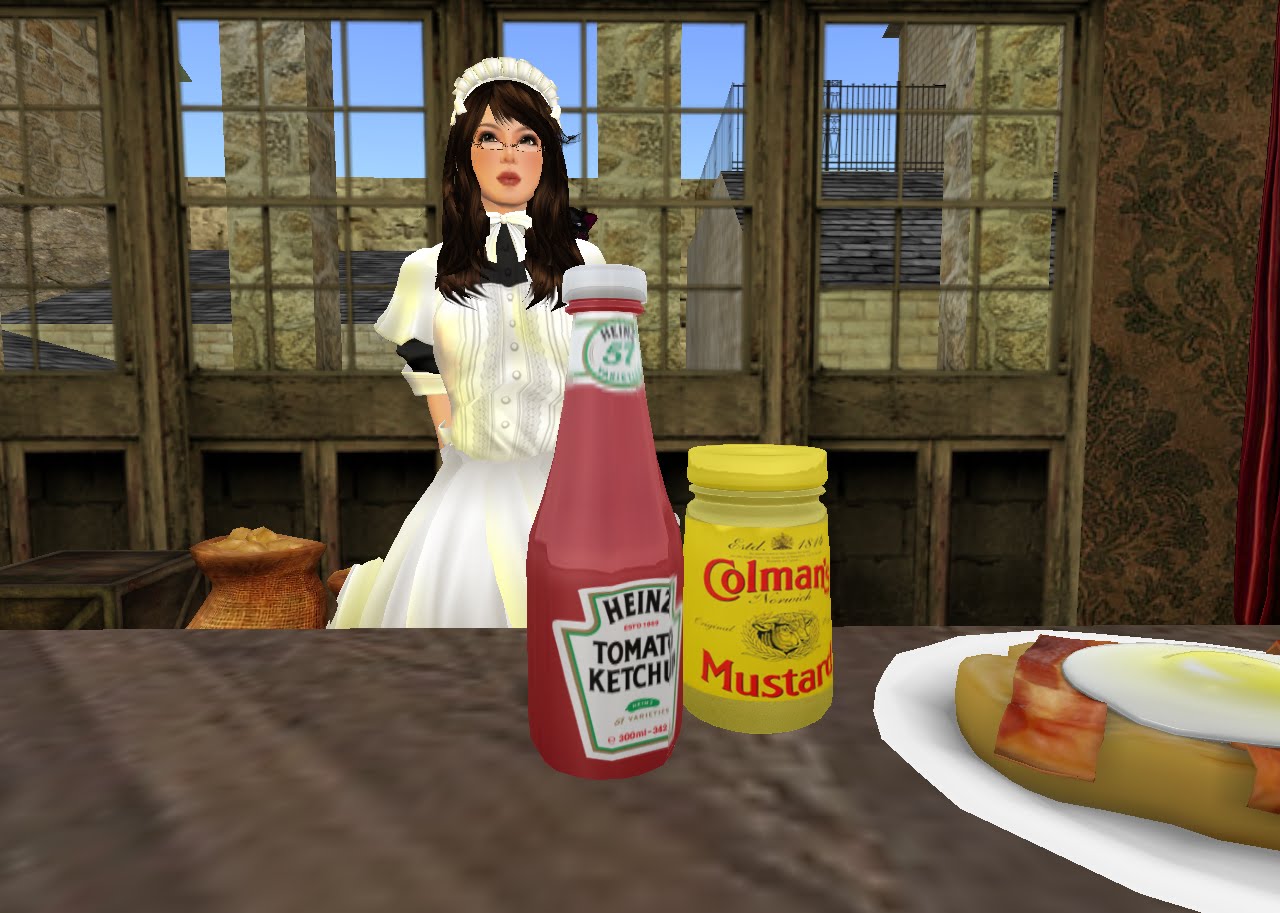
At La Café Poulard, a waitress will inveritably ask if you want to order an omelette. In real life, La Mère Poulard is renowned for its large fluffy omelettes. They beat their eggs until they are light and airy. Then the mixture is poured into a pan and cooked on wood-fired flames. It's a great show that is wonderfully replicated at La Café Poulard. On the counter at La Café Poulard, I was glad to find a bottle of Heinz Ketchup. The French would be aghast at this. But I don't care. I like ketchup on my omelettes.

Making Omelettes at La Café Poulard


On the second floor of La Café Poulard there is an outdoor patio looking out on the Bay of Mont Saint Michel.  It's my favorite spot to unwind and have come coffee or wine with friends after touring the abby.

Relaxing with Jaysun and my sister, Dawson


Midnight at Mont Saint Michel


I hope that you enjoyed this posting on Mont Saint Michel and now plan to visit this Second Life treasure. If you see me at La Café Poulard, let's sit together at the counter and share some great omelettes. And please pass the ketchup bottle.


Mont Saint Michel:
Mont Saint Michel on YouTube:


Official blog for Le Mont Saint Michel in Second Life